
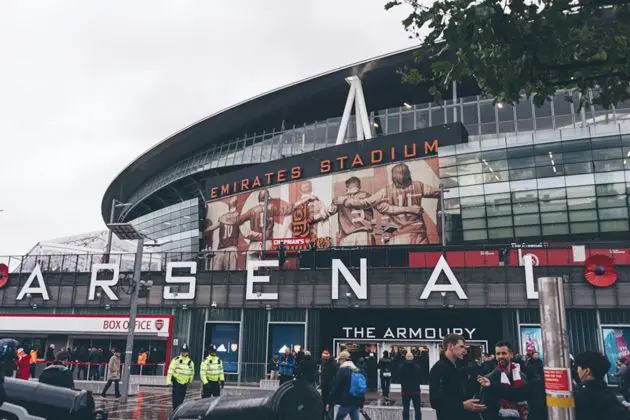
Arsenal’s 2025/26 season could well go down in history as one of the club’s finest ever. The Gunners are still alive on four fronts this term, topping both the Premier League and Champions League while also being through to the League Cup final and the fifth round of the FA Cup. But ask any regular attender of the Emirates, and there is one crown that they have placed higher than others.
Of course, claiming an unprecedented quadruple would make Mikel Arteta’s side, without question, the greatest team English football has ever seen. But is that a very real possibility? Chances are, the Gunners will have to prioritise one or two of the competitions they remain in contention for, and, if forced to choose, Gooners the world over would want their club to claim the Premier League above all others.
Arsenal’s Title Hopes
It’s been 22 long years since Arsenal last reigned as champions of England. This season, online betting sites have made them the overwhelming favourites to end their barren spell, but the recent 1-1 draw away at Brentford has set alarm bells ringing a little. The North London club’s advantage over Manchester City in the title race has shrunk to just four points, and the latest odds from the popular Lucky Rebel site have responded in kind, drifting to 2/7 from 1/4 before that trip to West London.
Should Arteta mastermind a title triumph, it would be Arsenal’s first since the legendary Invincibles of 2003/04. 22 years ago, Arsene Wenger’s Gunners won the Premier League without losing a single day, becoming the first team in over a century to achieve such a feat. But which of the current squad would make it into that famous team? Let’s take a look.
Gabriel Magalhães
Arsenal’s Invincibles were anchored by Sol Campbell and Kolo Toure, who formed a watertight backline ahead of goalkeeper Jens Lehmann. They conceded just 26 goals all season, but the current central defensive pairing of Gabriel Magalhães and William Saliba is worth celebrating in its own right. They too have proved to be the league’s meanest defence, allowing just 18 goals so far this term.
If you were to ask us a year ago, we’d have said William Saliba would slot alongside Campbell in a mythical XI, with Gabriel and Toure missing out. However, the Brazilian defender has arguably been Arsenal’s best player so far this season, and it’s impossible not to select him alongside Big Sol, ahead of his French teammate and the legendary Toure.
Gabriel’s playing at his absolute peak right now, leading by example. He’s vocal, constantly communicating, demanding concentration from teammates who might drift. He’s become what Sol Campbell was in 2003/04 – the defensive organiser you can’t replace.
Declan Rice
Gilberto Silva was nicknamed “The Invisible Wall” for good reason. He sat, he screened, he broke up play, and he let Patrick Vieira maraud forward, knowing someone responsible had his back. But here’s the uncomfortable truth: Declan Rice does everything Gilberto did and then adds a dimension the Brazilian never offered.
Rice has four goals and three assists in 25 matches this season. Gilberto managed one or two per season if you were lucky. Rice takes 1.38 shots per 90 minutes, creates 2.14 key passes per match, and his expected assists output puts him above 94% of Premier League players. He’s evolved from a pure destroyer into a genuine box-to-box midfielder who impacts both ends. And his set-pieces aren’t bad either: That pair of free kicks against Real Madrid, anyone?
Bukayo Saka
Freddie Ljungberg was magnificent during the Invincibles season, providing energy, goals, intelligent movement that terrorised defences, and creating opportunity after opportunity for the talismanic Thierry Henry. His ability to make those perfectly-timed runs into the box, arriving late like a ghost, and suddenly it’s 1-0 Arsenal.
But Bukayo Saka? On his day, he operates on another level entirely.
Saka’s got four goals and three assists in 22 Premier League matches, but those numbers don’t capture his influence. Here’s what separates him from Ljungberg: Saka creates constantly. Ljungberg was direct, running onto things; Saka manufactures chances from nothing.
The Englishman is devastating one-on-one, cutting inside onto his left or going outside on his right, keeping fullbacks guessing for a full 90 minutes. His decision-making at 24 is absurdly mature – he knows when to dribble, when to pass, when to shoot. Ljungberg had intelligence in his movement off the ball, but Saka influences games more comprehensively, hence why he’s in our team.
Martin Ødegaard
This one hurts. Genuinely hurts. Dennis Bergkamp was an artist – his first touch could stop traffic, his vision unlocked defences nobody else saw, his footballing intelligence bordered on supernatural. But here’s the uncomfortable reality: the non-flying Dutchman was 34 throughout the Invincibles’ run. He wasn’t the iconic presence that he was in Arsenal’s first title under Arsene Wenger years prior. Ødegaard, meanwhile, is playing some of the best football of his career right now.
What gives Ødegaard the edge, barely, is his mobility and intensity. He covers significantly more ground than late-career Bergkamp, presses relentlessly, and maintains influence for the full 90 minutes. Bergkamp, by 2003/04, couldn’t press like modern football demands. This isn’t saying Ødegaard’s better than prime Bergkamp, he absolutely isn’t. But for this combined XI’s needs, the team needs a number 10 who orchestrates and works defensively. Ødegaard is the man for the job.